

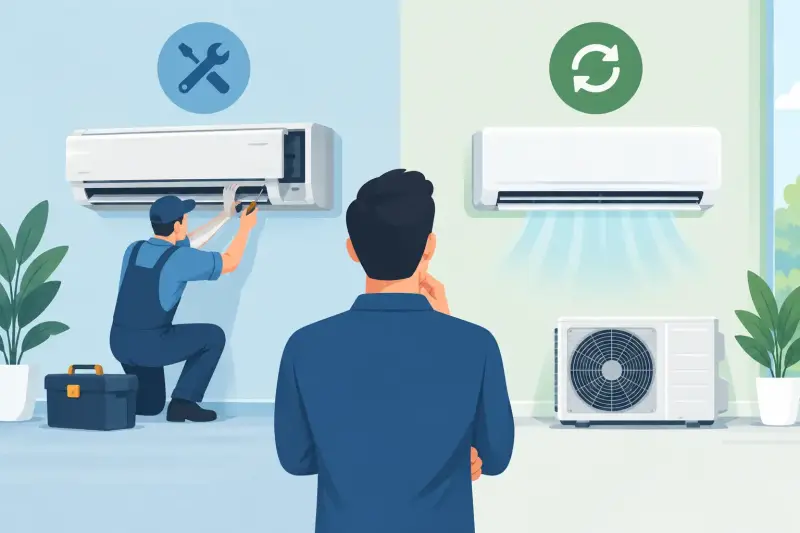
Repair Versus Replace AC: Make the Right Call
A cooling problem rarely arrives at a convenient time. Your AC may start blowing warm air during an Anaheim heat spell, make an unfamiliar sound before opening hours, or stop keeping bedrooms and workspaces comfortable. In that moment, the repair versus replace AC decision can feel urgent, but it should not be a guess. The right answer depends on the system’s condition, the cost of the repair, and what your property needs from it over the next several years.
A qualified technician should begin with diagnosis, not a sales pitch. Some AC issues have straightforward fixes, such as a failed capacitor, worn contactor, clogged drain line, refrigerant leak, or damaged electrical connection. Other problems point to an aging system that may continue to demand costly attention. Knowing the difference protects both your comfort and your budget.
Start With the Actual Cause of the Problem
An AC that will not cool properly is not automatically ready for replacement. Dirty filters, blocked outdoor coils, thermostat issues, tripped breakers, and maintenance-related airflow restrictions can all reduce performance. These conditions may be repairable without major expense, especially when the equipment is otherwise in sound condition.
The diagnosis matters because symptoms can overlap. Short cycling, for example, may be caused by an oversized unit, a refrigerant issue, a dirty coil, a failing control component, or ductwork problems. Replacing equipment without identifying the underlying cause can leave you with a new system that still performs poorly.
For commercial properties, this step is particularly valuable. Uneven temperatures, repeated tenant complaints, or high utility use may involve controls, zoning, ventilation, or ductwork in addition to the AC unit itself. A clear assessment helps facility managers address the source of disruption rather than simply replacing the most visible component.
When AC Repair Usually Makes Sense
Repair is often the sensible choice when the system is under 10 years old, has received regular maintenance, and needs an isolated repair. A quality air conditioner can often provide 12 to 15 years of service, sometimes longer when it is properly sized, installed correctly, and maintained consistently.
A repair may be the better value when the cost is modest compared with the price of replacement and the rest of the system is operating reliably. Replacing a capacitor, fan motor, thermostat, contactor, or drainage component can restore dependable cooling without committing to a large immediate investment.
Repair can also make sense when you expect to sell a property soon or when a larger property improvement plan is already scheduled. In those cases, a targeted repair may keep the building comfortable while giving you time to plan a replacement around your timeline instead of an emergency.
That said, a low-cost repair is not always the full picture. If it is the third service call in one summer, the issue is no longer only the price of the latest part. Consider service interruptions, lost work time, uncomfortable occupants, and the likelihood that another component may fail soon.
Repair Versus Replace AC: The Cost Test
Many property owners have heard a version of the 50 percent rule: if a repair costs half the price of a new system, replace the system. It is a useful starting point, but it is not a complete decision tool. A $2,000 repair on a relatively new, high-quality system may be reasonable. The same repair on a 15-year-old unit with prior breakdowns may not be.
Look at the repair cost alongside the unit’s age, repair history, efficiency, and expected remaining life. Ask for a straightforward quote that separates the immediate repair from replacement options. That allows you to compare today’s expense with the likely cost of keeping the existing unit operating for another one, three, or five years.
For businesses, include the cost of downtime in the calculation. A restaurant, office, retail location, or rental property may lose far more than the repair invoice if cooling fails during a busy period. A proactive replacement can be easier to schedule and less disruptive than waiting for an older system to fail completely.
Age and Refrigerant Can Change the Equation
Age is not an automatic replacement verdict, but it is one of the strongest factors. Once an AC unit reaches the 12- to 15-year range, major repairs deserve closer scrutiny. Parts may be harder to source, efficiency may have declined, and normal wear may be affecting more than one component.
The type of refrigerant also matters. Older systems using R-22 refrigerant can be expensive to repair when they develop a leak because R-22 is no longer manufactured or imported for new use in the United States. Recharging an R-22 system may restore cooling temporarily, but it does not solve the leak and can become a costly repeating expense.
Newer systems use currently available refrigerants and typically offer improved efficiency. If an older R-22 unit needs a compressor, evaporator coil, or major refrigerant repair, replacement is often the more practical long-term choice. A technician can explain the available options based on your specific equipment rather than relying on a one-size-fits-all rule.
Comfort, Efficiency, and Reliability Matter Too
An AC system can still run while falling short of what your property needs. Rising utility bills, hot rooms, excess humidity, loud operation, weak airflow, and frequent cycling are signs that performance should be evaluated. In Southern California, cooling demand may not be as constant as in some climates, but a poorly performing system is still frustrating when temperatures climb.
A replacement may improve comfort through better sizing, variable-speed operation, updated controls, and more consistent airflow. However, efficiency gains depend on proper installation. The right equipment must be matched to the building, ductwork, electrical setup, and cooling load. An oversized AC can short cycle and struggle with humidity control, while an undersized system may run continuously without reaching the desired temperature.
For homeowners, a replacement can provide more predictable comfort and fewer surprise repair calls. For commercial decision-makers, it can support tenant satisfaction, employee productivity, and more stable operating costs. The benefit is not simply a newer box outside the building. It is a cooling system designed to perform reliably in the actual space.
Do Not Overlook Maintenance History
Maintenance records tell a useful story. A system that has received seasonal inspections, coil cleaning, filter changes, drain checks, and electrical testing is easier to evaluate than one that has been neglected for years. Regular service can catch small problems before they become compressor damage, drain overflows, or complete system shutdowns.
If a unit has been dependable and its current issue is isolated, repair may extend its useful life with confidence. If maintenance has been inconsistent and multiple parts are showing wear, replacement may prevent a cycle of emergency calls. This is also a good time to review duct condition, thermostat controls, and indoor air quality needs, since these factors affect how well any AC system performs.
Preventive maintenance remains valuable after either decision. A new AC still needs service to protect efficiency and warranty requirements, while an older repaired unit needs monitoring to help you plan ahead rather than react under pressure.
Questions to Ask Before Approving the Work
Before choosing a path, ask the technician how urgent the repair is, whether the failure is isolated or part of a larger pattern, and how long the existing system may reasonably last. Ask whether refrigerant leaks, ductwork, electrical concerns, or installation issues are contributing to the problem.
It is also reasonable to request repair and replacement estimates side by side. A useful quote should explain what is included, what equipment is being recommended, and what performance improvement you can realistically expect. HVAC Pros approaches these decisions with the goal of giving property owners a clear diagnosis and a straightforward quote, whether the right next step is a focused repair or planned replacement.
The best decision is the one that fits the condition of your equipment and the needs of your property, not the one made fastest under stress. A careful diagnosis today can restore comfort now and help you avoid a more disruptive cooling failure later.